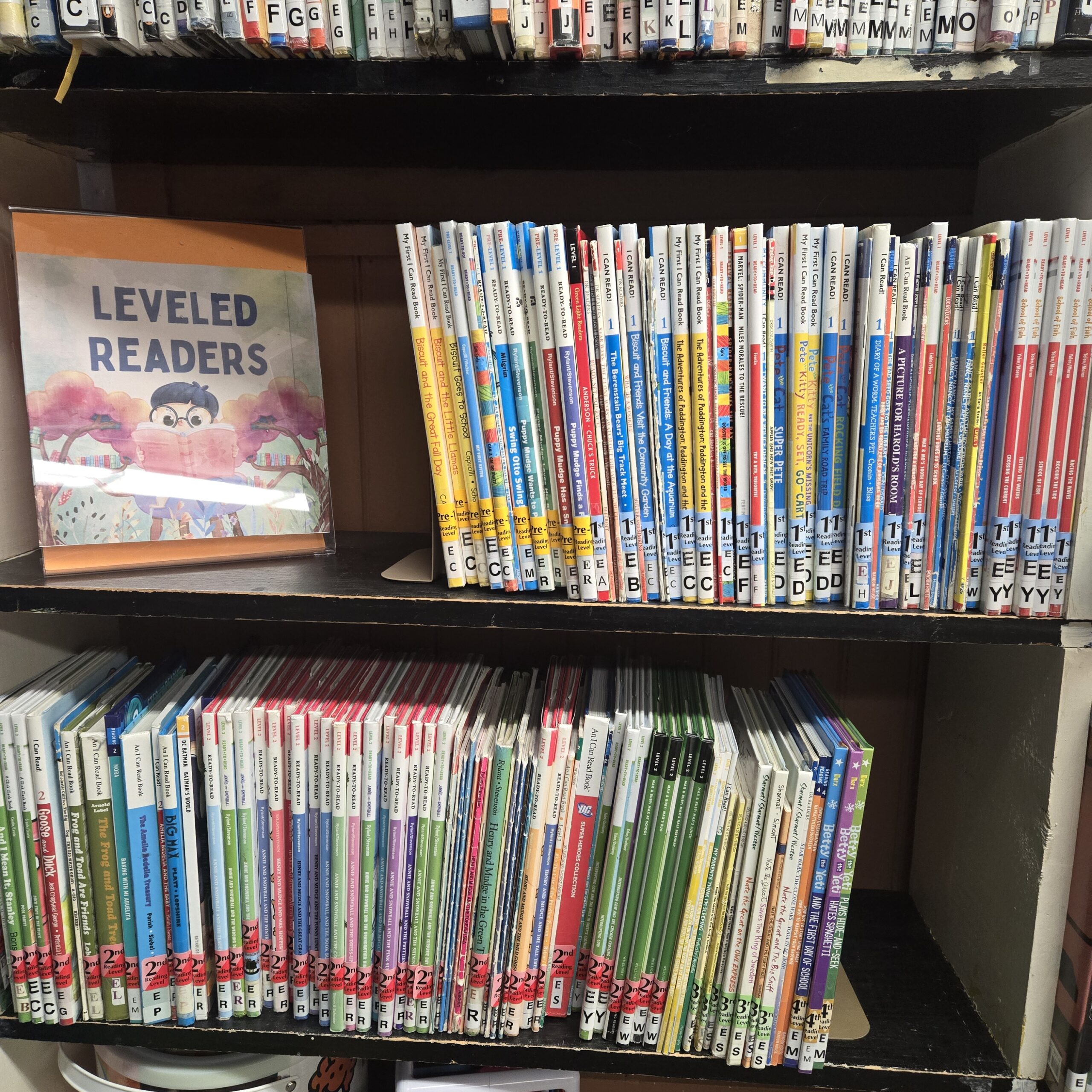
Learning to read is a complex skill and supporting your child as they learn to read can be difficult. Once children start public school, you may hear a lot about their “reading level.” It’s important to understand that a reading level is a suggestion not a rule. It is only an estimate that a child will read at a particular level in a particular grade. Each school district might use a different system for measuring reading level, as there are many different models available. Many publishers of children’s books available in the library are also given a level that roughly matches levels a school might use. Popular examples of publishers creating leveled books are Ready-to-Read, ICanRead, and Penguin Young Readers. At the library, these books are in their own section for easy location.
We know that children grow and learn at their own pace. This guide is simply to help support reading at home. If you know your child’s reading level at school, choosing a leveled reader from the library collection can be easier with this chart.
Ready to Read
Level
Description
Grade
Fountas & Pinnell (Guided Reading)
Lexile Level
ATOS (Accelerated Reading)
Pre-Level 1
Emergent Readers Shared reading Familiar characters Simple words
Pre-K –Kindergarten
D-I
100-300
K-1.8
Level 1
Starting to read on their own High frequency words Simple plot and dialogue Familiar topics and themes
1st grade
G-K
200-400
1.5-2.3
Level 2
Independent readers Longer sentences High interest vocabulary
1st grade-2nd Grade
I-N
300-600
1.7-3.0
Level 3
Confident readers Longer plot Challenging vocabulary More difficult sentence structure
2nd-4th Grade
L-R
500-700
2.6-4.3
Chart of Ready-to-Read books and corresponding reading levels.
I Can Read
Level
Description
Grade
Fountas and Pinnell (Guided Reading)
Lexile Level
ATOS (Accelerated Reading)
Pre-Level 1 “My First Shared Reading”
Basic language Word repetition Whimsical illustrations Share with emergent reader
Pre-K & Kindergarten
A-D
0-100
K-1.1
Level 1 “Beginning”
Short sentences Familiar words Simple concepts
1st Grade
E-I
100-300
1.2-1.8
Level 2 “Reading with Help”
Engaging stories Longer sentences Language play For developing readers
1st-2nd Grade
J-M
400-500
2.0-2.9
Level 3 “Reading Alone”
Complex plots Challenging vocabulary High interest topics for independent reading
3rd Grade
N-P
600-700
3.0-3.6
Level 4 “Advanced Reading”
Short paragraphs Beginning chapters Exciting themes Bridge to chapter books
3rd-4th Grade
O-R
600-700
3.3-4.3
ICanRead books and their corresponding reading levels.
Penguin Young Readers
Level
Description
Grade
Fountas and Pinnell Guided Reading Level
Lexile Level
ATOS (Accelerated Reading)
Level 1- Emergent reader
Simple vocabulary Word repetition Picture clues Predictable story and sentence structure Familiar ideas
Pre-k and Kindergarten
A-D
0-100
K-1.1
Level 2- Progressing Reader
Longer sentences Simple dialogue Picture and context clues More plot development Nonfiction and fiction
1st Grade
E-I
100-300
1.2-1.8
Level 3- Transitional Reader
Multisyllable and compound words More dialogue Different points of view Complex storylines and characters
1st-2nd Grade
J-M
400-500
2.0-2.0
Level 4- Fluent Reader
More advanced vocabulary Detailed, descriptive text Complex sentence structure In-depth plot and character development
3rd Grade
N-P
600-700
3.0-3.6
Penguin Young Readers series and their corresponding reading levels.